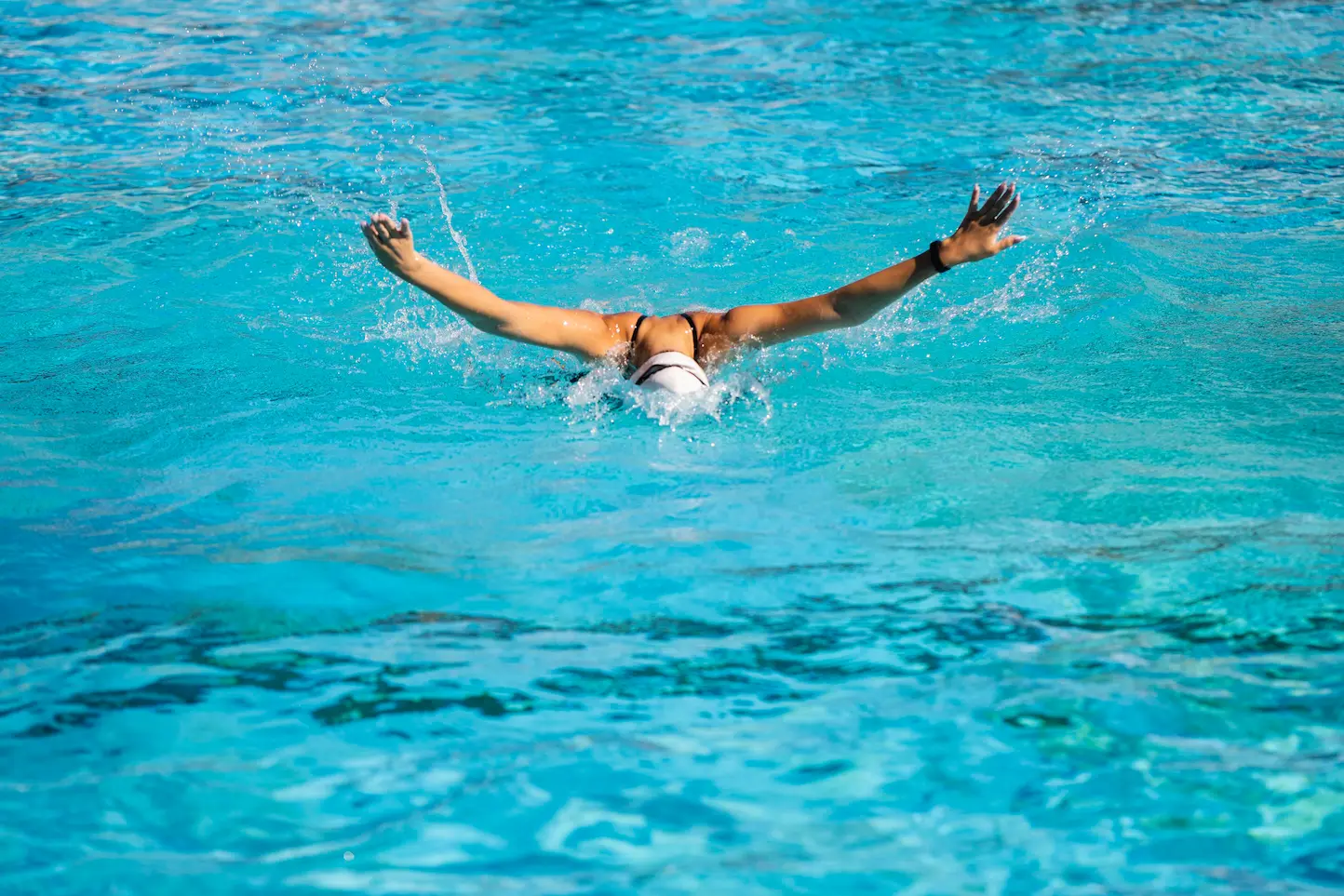
Any endurance sport directly depends on the force we apply in each specific movement. This means that the limiting factor or the main quality of each movement in the water directly depends on our strength.
If we are not strong enough, we won’t be able to apply the necessary force in the water or maintain long stroke lengths.
This required strength is determined not only by the time we have to apply it (during the stroke at a given pace), but also by the instability of the medium in which we apply it (the water).
How to gain strength for the butterfly stroke: Step by step guide
Therefore, it is essential to start by training strength on land, initially through general but useful exercises, meaning those that involve the same movements (connecting muscle groups) that we use in swimming.
Later, we transfer this work to other movements that apply force in gestures similar to swimming, but on land (e.g., elastic bands, isokinetic machines, etc.), and then transfer them to the water with specific gestures that help us apply the maximum possible/necessary force at different swimming paces, both educationally and functionally, until we reach the competition pace.
This useful strength is trained, from this perspective, at different intensities, depending on the type of work we want to do.
If the goal is to improve speed in short or long distances, the training is designed by considering those distances and the appropriate rest intervals, as if we were working on specific endurance for each case, including supra-speed (speeds above the ranges and force applications above the actual competition needs).
For this, we can use different materials such as parachutes, paddles, power towers, elastic bands… In the case of supra-speed with pulleys, assisted bands, or hydrodynamic flow channels (flumes).
Each of these elements provides a different type of resistance or power-RFD (we use this term for better understanding. In any case, it shouldn’t be considered as much for the term itself—RFD—as because there is no direct application of force in the water, due to the instability of the surface), allowing us to adapt the training to our goals.
Furthermore, we can transfer the work with equipment to work without equipment. For example, if we want to improve maximum strength, we can do fewer repetitions with paddles and parachutes within a specific gesture in the water.
Then, we remove the equipment and try to complete the same distance with the same effort, but without assistance, thus optimizing the application of force during competition. This is achieved by a greater activation of muscle fibers that break the effort economy (post-activation potentiation), as well as through the educational element of managing effort directly in habitual swimming at competition speeds.